


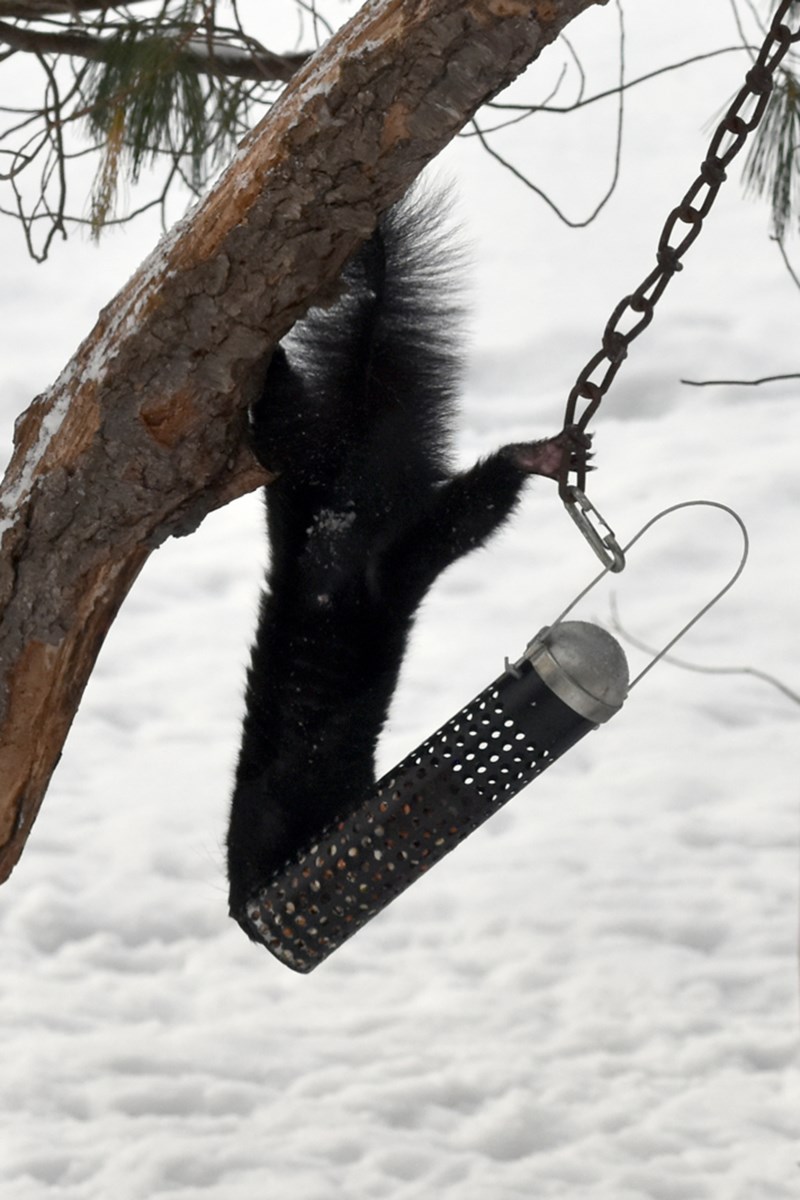

Squirrels of various colors are among the many mammals who like to take advantage of the bounty found at local bird feeders
There’s snow on the ground and a bite to the gusty breeze… time to set out the bird feeders. I usually wait until the birds are getting a bit desperate to find natural food, as our farm has oodles of grapes, apples, acorns (some years, no this year), weed seeds and goldenrod galls (with a juicy little fly larvae inside) .
Our combo of black oil sunflower seeds, peanuts, cracked corn and suet attracts a wide variety of winter birds, from the common chickadees and blue jays to the uncommon visits from evening grosbeaks and pine siskins. Daily records of feeder visitors, kept since 1998, reveals an array of avian activity over the decades.
And while the intent of the feeders is to attract birds, there are always a small herd of mammals that take advantage of the free food. Over the years there have been shrews, meadow voles, red squirrels, gray squirrels, flying squirrels, coyotes, raccoons, ermine and deer that have dropped by. Lucky us, no bears yet!
Because of this eclectic mix of wildlife taking advantage of our good nature… we no longer call them bird feeders, now just referred to as wildlife feeders.
This year the squirrels are dominating the diner, with two red squirrels vying for an opening against about eight black squirrels. Did you catch that? I called them black squirrels. What kind of amateur naturalist makes that mistake? Eastern gray squirrels, okay?
The past couple years we did indeed have gray Eastern gray squirrels, but this year the tree branches are covered with black Eastern gray squirrels. So what’s up with this color difference?
As the proper name implies, this perky species is supposed to be gray in color and found in the eastern portions of North America. But now they seem to be ‘everywhere’ and come in a variety of colors from gray to bronze to black. Apparently this is the result of genetics gone wild.
If one copy of the alternate pigment gene is found within the DNA, a brownish-blackish Eastern gray squirrel is produced; however, if two copies are present the pigment changes the fur to completely black. And to add to the fun, a litter of squirrels may contain both gray and black offspring.
This black color variant is common in southern Ontario and parts of Ohio. Otherwise the more southern parts of the species’ range contain the normal grey-coloured gray squirrels. As we live in southern Ontario, that makes us special, as we have the monopoly on black gray squirrels.
This double standard of color is a form of melanism, whereas the animal does not change or morph its color with age or other influencers. One theory is that the black fur absorbs sunlight better than light grey, thus allowing better survival in cold winters, hence the black colored squirrels being more common in the north portion of their natural range (which is here in the hardwood region of southern Ontario) .
This squirrely quirk did not go unnoticed by our neighbors to the south, and biologists and park keepers in Washington DC coveted our black variants. In the early 1900s it seemed that the trap and transfer of species was a common and accepted practice. Some Eastern gray squirrels were shipped from Ontario to British Columbia to enhance their landscapes. And the National Zoological Park in Washington DC had put in a request.
In 1902 the Ontario government swapped eight ‘black’ squirrels for eight ‘grey’ squirrels, the transfer site being Rondeau Provincial Park. Both parties were pleased with the results as reported within their annual summations a few years later.
The Canadian ‘black’ squirrels soon escaped from the Zoological Park and headed into town. They set up camp on a way cool green space with big oak trees and beside a large white house. Or should I say, White House. To this day, the presidential occupants enjoy watching the antics of these jet-black Canadian descendants frolicking on the grounds. Indeed, the whole city has a certain civic pride in hosting these furry black immigrants.
Here’s an aside: what does ‘jet-black’ mean? Any jets I’ve seen are usually white, silver and maybe a light grey. Turns out that I’m wrong in my assumption of this word’s roots (hey, what else is new?).
Jet is a gemstone, very dark in colour, that is a cousin to coal. It is formed from wood that is subject to immense pressure and water. Depending on whether the water was fresh or salty the result is either hard or soft jet. And both are as deep of black in color as you can imagine.
This black gemstone has been mined for centuries and fashioned into everything from rings to rosary beads.
So on your next stroll through the park, you should observe a small mammal with jet-black fur skipping about, pause to consider how unique it is that we share this part of its range. Black gray squirrels, you say? Made in Ontario!