




All major APAC, European, and US equity indices closed higher.
US government bonds closed mixed with the curve was slightly
flatter on the day, while all benchmark European bonds closed
higher. European iTraxx and CDX-NA closed tighter across IG and
high yield. The US dollar and natural gas closed lower, while oil,
gold, silver, and copper were higher on the day. The market will
closely be watching tomorrow’s 8:30am ET US Consumer Price Index
release for signs that the rate of inflation is slowing.
Please note that we are now including a link to the profiles of
contributing authors who are available for one-on-one discussions
through our Experts
by IHS Markit platform.
Americas
- All major US equity indices closed higher; Nasdaq +2.1%,
Russell 2000 +1.9%, S&P 500 +1.5%, and DJIA +0.9%. - 10yr US govt bonds closed +1bp/1.95% yield and 30yr bonds
-1bp/2.25% yield. - CDX-NAIG closed -1bp/62bps and CDX-NAHY -9bps/341bps.
- DXY US dollar index closed -0.2%/95.49.
- Gold closed +0.5%/$1,837 per troy oz, silver +0.6%/$23.34 per
troy oz, and copper +3.2%/$4.60 per pound. - Crude oil closed +0.3%/$89.66 per barrel and natural gas closed
-5.6%/$4.01 per mmbtu. - The US Army on February 8 released a climate-change strategy
that, among other things, outlines an ambition to install a
microgrid on every installation by 2035. There are over 130 Army
installations around the world that protect, support and enable the
force. In the last five years alone, the Army said it has enhanced
installation-wide resilience by bringing systems online such as
Fort Irwin’s water treatment plant upgrade, Fort Knox’s 2.1-MW
solar field and Fort Carson’s 8.5-megawatt-hour lithium battery.
There are 950 renewable energy projects supplying 480 MW of power
to the Army today and 25 microgrid projects scoped and planned
through 2024. The policy goals also include (IHS Markit
PointLogic’s Barry Cassell):- To achieve on-site carbon pollution-free power generation for
Army critical missions on all installations by 2040. - To provide 100% carbon-pollution-free electricity for Army
installations’ needs by 2030. - To implement installation-wide building control systems by
2028. - To achieve 50% reduction in greenhouse gas (GHG) emissions from
all Army buildings by 2032, from a 2005 baseline.
- To achieve on-site carbon pollution-free power generation for
- Averaged over the last seven days, and after seasonal
adjustment, passenger throughput at US airports was 81.2% of the
January 2020 level. This is close to recent averages and likely was
held down by disruptions across the central and eastern US stemming
from Winter Storm Landon. (IHS Markit Economists Ben
Herzon and Lawrence Nelson) - Ram has created a hub called RamRevolution.com to bring
consumers into the process of creating the first Ram electric
pick-up truck, due to be launched in 2024. According to a statement
from Ram, the Ram Revolution ‘insider program’ of consumer
consultation will “provide consumers with unique content and a
closer connection with the Ram brand and its electric-vehicle (EV)
philosophy”. Ram is also beginning a series of year-long
discussions with truck owners to better understand what they
require an electric pick-up to do to meet their real-world needs.
Ram has provided some images indicating what the silhouette of the
new electric pick-up might look like. The brand says the images are
of a concept vehicle “being developed with customer input to
inspire the design of the upcoming Ram 1500 EV”. In addition, Ram
stated that, by 2025, it plans to introduce fully electrified
products in the majority of the segments it has entries in, and a
full portfolio of electrified products in all of these segments no
later than 2030. In the company statement, Mike Koval Jr, Ram brand
CEO – Stellantis, said, “Our new Ram Revolution campaign will allow
us to engage with consumers in a close and personal way, so we can
gather meaningful feedback, understand their wants and needs and
address their concerns – ultimately allowing us to deliver the best
electric pickup truck on the market with the Ram 1500 BEV.” (IHS
Markit AutoIntelligence’s Stephanie
Brinley) - Embark will supply its autonomous trucks to freight
transportation company Knight-Swift in a pilot program, according
to a company statement. The Truck Transfer Program will allow
Knight-Swift to own an autonomous truck, maintain and deploy the
truck, and place its own driver behind the wheel. This program will
support both the companies to “collect driver feedback on the
technology’s performance, define how the system will improve driver
jobs, and develop procedures and tools that enable Knight-Swift to
maintain, inspect, dispatch, and remotely monitor Embark-equipped
trucks”. The Embark Universal Interface (EUI), the company’s
autonomous hardware and software stack, will be installed in a set
of Knight-Swift trucks scheduled for OEM deliveries in 2022. (IHS
Markit Automotive Mobility’s Surabhi Rajpal) - Lyft has reported net loss of USD258.6 million in the fourth
quarter of 2021, compared with a net loss of USD458.2 million in
the same period of 2020, according to a company statement. This
loss was attributable to stock-based compensation and related
payroll tax expenses, as well as expenses related to changes to the
liabilities for insurance required by regulatory agencies
attributable to historical periods. The company reported its third
consecutive quarter of adjusted EBITDA profitability, of USD74.7
million, in the fourth quarter of 2021. The company’s revenue
increased to USD969.9 million in the quarter, up 70.0% year on year
(y/y) and 12.0% quarter on quarter (q/q). Lyft said that the growth
in revenue was attributable to increased revenue per active rider,
which rose by 14.1% y/y to USD51.8. The number of active riders
also increased, to 18.7 million, in the period, up 49.2% y/y. Lyft
chief financial officer Elaine Paul said, “We had a solid Q4 and
achieved full-year revenue growth of 36 percent in 2021. Revenue
per Active Rider, Contribution Margin and Adjusted EBITDA all
reached new highs in the fourth quarter, driven by improving
service levels and higher ride volumes in our marketplace. Despite
short-term headwinds from omicron, we remain optimistic about
full-year 2022.” Lyft closed 2021 with its first annual profit of
USD92.9 million on an adjusted EBITDA basis. Last year, Lyft
announced plans to resume a shared-ride booking option, which
allows multiple passengers travelling in the same direction to
share a car, in Chicago, Philadelphia, and Denver, United States.
With a resurgence in the number of users, Lyft and its rival Uber
are struggling with driver supply and demand imbalances, leading to
higher pricing and increased waiting time. (IHS Markit Automotive
Mobility’s Surabhi Rajpal) - According to the National Institute of Statistics and Censuses
(Instituto Nacional de Estadistica y Censos: INEC), Costa Rica’s
Consumer Price Index (CPI) edged up to 3.5% y/y in January, almost
unchanged from the previous month. This marked the highest reading
since February 2015 and was slightly above of our expectations of
3.4%. (IHS Markit Economist Dariana Tani)- However, January reading remains within the target range of
between 2% and 4% established by the BCCR. - On month-on-month (m/m) terms, the CPI rose by 0.4% m/m, with
rental and housing services showing the largest monthly price
increases, followed by recreational activities and food and
non-alcoholic beverages. - Moreover, separate data from INEC show that the country’s
unemployment rate continued to fall gradually during the last
quarter of 2021, which in part reflects the ongoing recovery of the
tourism sector and the ease of global travel restrictions, despite
the new wave of COVID-19 cases related to the new Omicron
variant. - Nevertheless, the latest BCCR’s Monetary Policy Report released
on 29 January showed that in recent moving quarters, the drop in
the unemployment rate was more related to people leaving the labour
force, noting that this was the case, for example, in the moving
quarters that ended in October and November 2021.
- However, January reading remains within the target range of
Europe/Middle East/Africa
- All major European equity markets closed higher; Italy +2.7%,
Spain +2.0%, Germany +1.6%, France +1.5%, and UK +1.0%. - 10yr European govt bonds closed sharply higher; Italy -7bps,
Germany/UK -6bps, Spain -5bps, and France -4bps. - iTraxx-Europe closed -2bps/62bps and iTraxx-Xover
-7bps/303bps. - Brent crude closed +0.8%/$91.55 per barrel.
- The UK government has greenlit a plan to build a large-scale
battery production facility in Coventry (UK), reports the Coventry
Telegraph. The newspaper reports that an outline planning
application for the West Midlands Gigafactory was set to
“called-in” by the Secretary of State for Housing, Communities and
Local Government Michael Gove. However, a decision has now been
taken not to review the application, meaning a detailed planning
application will be allowed to be submitted once a backer can be
found to build and run the facility. (IHS Markit AutoIntelligence’s
Ian Fletcher) - German Federal Statistical Office (FSO) external trade data
(customs methodology, seasonally and calendar-adjusted, nominal)
reveal that exports increased by 0.9% month on month (m/m) in
December 2021, extending a combined near-6% rebound already
observed during October-November 2021. The latest export level
exceeds that of February 2020, just before the pandemic, by about
7%. Imports even surged by 4.7% m/m, although this was partly
caused by sharply increasing import prices. That said, December
2021 volume data show that stagnating exports contrast with a 4.6%
m/m increase for imports. (IHS Markit Economist Timo
Klein)- Based on the seasonal- and calendar-adjusted series,
year-on-year (y/y) rates for December 2021 export and import values
have now reached 11.8% and 24.7%, respectively. However,
corresponding y/y rates in volume terms are only 0.8% and 0.7%,
highlighting the huge impact of inflation developments in 2021 for
external trade data. - The seasonally adjusted trade surplus, which had peaked at
EUR21.8 billion in January 2021 following the initial recovery from
the COVID-19 virus outbreak, narrowed anew from EUR10.8 billion in
November 2021 to EUR6.8 billion in December 2021. This is well
below monthly averages not only in 2019 (EUR18.9 billion) but also
in 2020 (EUR14.8 billion), the year already hit by the outbreak of
the pandemic.
- Based on the seasonal- and calendar-adjusted series,
- Volkswagen (VW) Passenger Cars has said that it will pay out a
COVID-19 premium to its employees for the second time to thank them
for their efforts during the pandemic. According to a company press
release, VW will pay out a EUR500 (USD571) bonus per employee as
part of the February salary round. The VW brand’s chief human
resources officer Gunnar Kilian said, “In recent months, the
pandemic greatly tested our employees – whether they were working
at our locations or remotely. The flexibility and tireless
dedication they have shown is a remarkable performance that we
would like to recognize. That is the reason for the new coronavirus
premium.” At the same time, Autocar has reported that the
forthcoming ID.Buzz battery electric passenger van will be priced
below EUR60,000 (USD68,600), according to company sources, a
similar price to that of the current internal combustion engine
(ICE) equivalent in the VW range, the VW Multivan T6.1. Perhaps
surprisingly, the panel van version of the ID.Buzz will be priced
below the equivalent ICE transporter, according to the report. In
Germany, the price could drop below EUR50,000 after government
incentives are deducted. (IHS Markit AutoIntelligence’s Tim
Urquhart) - According to the Italian National Institute of Statistics
(Istituto Nazionale di Statistica: ISTAT), industrial production
fell 1.0% month on month (m/m) in December 2021 after a 2.1% m/m
gain in November. (IHS Markit Economist Raj
Badiani)- Apart from a negative base effect after a robust performance in
November, industrial output in December was weighed down by staff
shortages and the Omicron-related disruption both in Italy and key
export markets. - The average level of industrial production rose by 0.5% quarter
on quarter (q/q) in the fourth quarter of 2021, compared with gains
of 1.0% q/q in the third quarter and 1.2% q/q in the second. - Industrial output in December was 2.0% above its February 2020
level, the last pre-pandemic month. - Output in December fell in consumer durables (-4.8% m/m),
intermediate goods (-0.5% m/m), and investment goods (-2.2%
m/m). - Meanwhile, on a working-day-adjusted basis, total industrial
output in December rose by 4.4% when compared with a year
earlier. - Therefore, industrial production rose by 11.8% in 2021 after a
drop of 11.4% in 2020. - The fall in industrial output in December was at odds with
survey data signaling improving output during the month.
Furthermore, the latest PMI indicators suggest that manufacturing
activity lost some momentum but still performed solidly in
January.
- Apart from a negative base effect after a robust performance in
- Although consumer price inflation surged to 8.6% year on year
(y/y) in December 2021, Poland’s MPC increased the policy interest
rate only moderately at its February session, keeping it below the
comparative figures for Czechia (at 4.50%) and Hungary (at 2.90%).
At the February session, the MPC also raised the required reserve
ratio from 2.0% to 3.5% while bringing the Lombard rate to 3.25%
and the discount and rediscount rates to 2.25% and 2.80%,
respectively. (IHS Markit Economist Sharon
Fisher)- In justifying the latest decision, the MPC pointed out that
global growth remains strong but is expected to decelerate in 2022.
Energy prices (particularly for natural gas, oil, and coal) as well
as agricultural commodities are increasing markedly, while supply
chain disruptions have continued and shipping costs remain high,
contributing to high global inflation. - Despite acknowledging that the risk of inflation running above
the 2.5% target over the medium term remains elevated, the National
Bank of Poland (NBP) appears less concerned about domestic
inflationary pressures and has been slower to react than many of
its counterparts elsewhere in Emerging Europe. Indeed, the NBP has
been focused not only on limiting inflation but also on supporting
sustainable economic growth. According to its February statement,
the NBP expects that a reduction in certain tax rates as part of
the ‘Anti-Inflation Shield’ will limit domestic inflation in early
2022, while interest rate hikes combined with the expected fading
of global shocks will also help ease pressures going forward. - IHS Markit continues to see significant upside risks to
inflation stemming from Poland’s tight labor market, with
enterprise wages up by nearly 10% y/y in the fourth quarter of
2021. Private consumption jumped by a preliminary 6.2% in 2021 and
an estimated 8.2% y/y in the fourth quarter of 2021 alone, serving
as a key driver of GDP growth.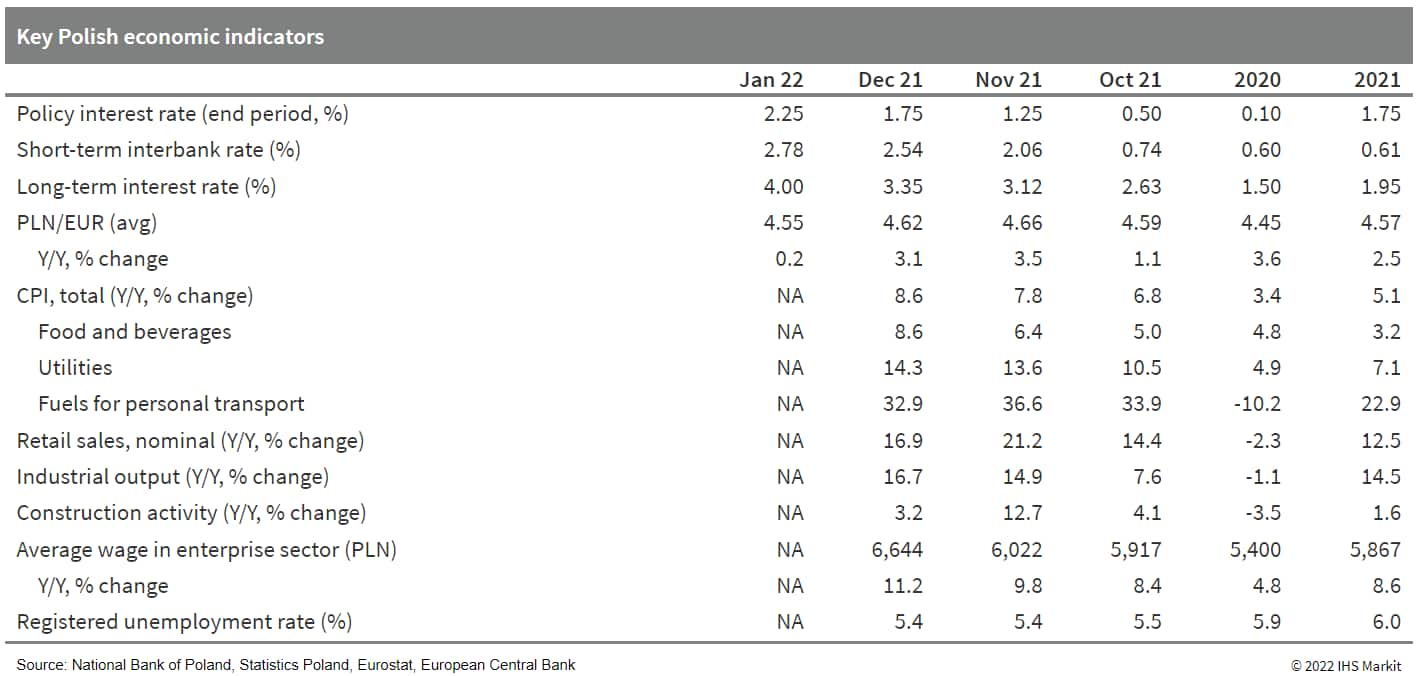
- In justifying the latest decision, the MPC pointed out that
- Volvo Cars has announced that it plans to invest around SEK10
billion (USD1.1 billion) to upgrade its Torslanda (Sweden)
facility, which will support its transition to a fully battery
electric vehicle (BEV) manufacturer. The investment in the site to
introduce the mega-casting process will coincide with a move to
shift vehicles from the current SPA architecture to the new SEA
platform. IHS Markit forecasts that the first new models to use
this will be the next-generation Volvo XC60 and the similar-sized
Polestar 4. We forecast annual production at the site peaking at
299,900 units in 2024, before sliding back towards the end of the
decade despite the introduction of new vehicles. (IHS Markit
AutoIntelligence’s Ian Fletcher) - Russia exported 34 million tons of grains and oilseeds and
their by-products as of February 3, down 19% y/y, according to the
Federal Centre of Quality and Safety Assurance for Grain. This
included 30 million tons of grains and pulses, and 28.7 million
tons of grains specifically. (IHS Markit Food and Agricultural
Commodities’ Louisa Sabin)- In particular, the country shipped 23.9 million tons of wheat,
2.8 million tons of barley, 1.8 million tons of corn, 1 million
tons of peas, 0.6 million tons of wheat bran, 0.2 million tons of
chickpeas, and 0.2 million tons of wheat flour. - Russia also exported 0.4 million tons of soybeans, 0.7 million
tons of sunflower meal, 0.5 million tons of flaxseed, and 0.2
million tons of rapeseed. - Meanwhile, Russia sold a total of 32.9 million tons of wheat
and meslin in 2021, down 14.4% compared to the previous year,
according to the Federal Customs Service. Additionally, Russia sold
3.1 million tons of sunflower oil in 2021, down 15.1% y/y.
- In particular, the country shipped 23.9 million tons of wheat,
- Petrofac has been awarded an early engineering services
contract by H4 Energy for a wind-to-hydrogen development project on
Sakhalin Island in Russia. As part of a three-year consultancy
framework agreement, Petrofac will explore options for using
predominantly wind energy to produce green hydrogen and other
sustainable sources of energy at the site on the south-western tip
of Sakhalin Island. (IHS Markit Upstream Costs and Technology’s
William Cunningham)- Initial work will evaluate hydrogen production technology,
hydrogen carriers such as liquid hydrogen and ammonia, export
options, turbine sizing, electrical systems, and hazards analysis.
Starting at 100 MW, Petrofac will also look at options for scaling
up to 3GW of total installed capacity in future phases, including
cost and execution phasing. The finished facility will target the
production of 17,000 metric tons of hydrogen per year. - Petrofac will undertake the work in Woking, United Kingdom with
support from a team based in Sakhalin. - Petrofac has been present in Sakhalin since 2006, when it
opened the Sakhalin Technical Training Centre, providing training
to operators and contractors in oil and gas projects. It expanded
its presence in 2017 through an EPC contract with Sakhalin Energy
for an onshore processing facility.
- Initial work will evaluate hydrogen production technology,
- The Turkish agricultural industry closed 2021 with a sharp rise
in prices. Its Producer Price of Index of Agricultural Products
rose by 36 % y/y in December 2021, being listed the following
product categories: citrus (+2%), rice (+20%); vegetables, melons
and tubers (+25%); sheep, goats and wool (21%); nuts and bush
fruits (36%); dairy cattle (+48% y/y); poultry and eggs (+49%);
cereals, leguminous and oilseeds (+67%); and fiber plants (+123%).
Turkey is a key cereal supplier to the Middle East and of several
edible nuts and dried fruits in the global markets (hazelnuts,
sultanas, dried apricots and dried figs, mainly). Fertilizer and
labor costs will be at the core of farming costs in 2022,
especially for labor-intensive crops such as stone fruits,
hazelnuts, grapes and figs. (IHS Markit Food and Agricultural
Commodities’
Jose Gutierrez)- Fertilizers: 120% year-on-year growth in November 2021, due to
the combination of rising international prices and lira
devaluation. Fertilizer imports reached 4.8 million tons valued at
$1.99 billion in 2021, 11% more year on year in volume and 78% more
in value. - Labor costs rose by 30% y/y. in November 2021.
- Energy (oil, gas and electricity) and lubricants: up 22% in
November 2021. - Pesticides: up 12% in November 2021.
- Seeds: up 9.5% in November 2021.
- Fertilizers: 120% year-on-year growth in November 2021, due to
- Shared mobility company GoTo Global is going public on the Tel
Aviv Stock Exchange (TASE) through a merger with Neratech Media.
According to the deal, the newly formed company, to be called GoTo,
will have a market value of USD163 million. GoTo Global
shareholders will receive 74% of the merged company’s stock and the
remaining 26% will be held by Neratech shareholders. GoTo Global
CEO Gil Laser said, “Transforming GoTo Global into a public company
is a significant milestone in achieving our unique vision for
shared mobility. People across the world are embracing shared
mobility at a faster pace than ever before and city dwellers are
becoming ever more multimodal. GoTo is perfectly positioned to help
users embrace a true multimodal mobility experience in a simple and
seamless way, all via one app. We believe in our product, our team
and our dynamic way of doing things and look to continue creating
added value for customers and shareholders alike.” GoTo Global
(also known as GoTo Mobility) is a mobility-as-a-service company
that provides users with access to shared cars, dockless bicycles,
and electric scooters through a single app. The firm started the
service in 2008 and currently operates in Israel, Germany, Spain,
and Malta. GoTo Global has 5,800 vehicles and over 450,000
subscribers, with nearly 3 million rides reported in 2021. (IHS
Markit Automotive Mobility Surabhi Rajpal) - According to data released by the Central Bank of Nigeria
(CBN), credit to the private sector increased by 18.5% year on year
(y/y) to NGN35.7 trillion (USD85 billion) in December 2021,
compared with year-on-year private-sector credit growth of 13% in
December 2020. The data also show that year-on-year credit to the
government slowed to 10.7% in December 2021, compared with
year-on-year growth of 30% in 2020. According to the Business Day,
a local newspaper, the main beneficiaries of the loan extension was
the oil and gas sector, accounting for nearly 16.2% of the total
disbursed loans in September 2021, followed by manufacturing and
commerce. (IHS Markit Banking Risk’s Ana Souto)- IHS Markit analysts expect a recovery of economic growth in
Nigeria in 2022 because of a rebound in oil prices. The hydrocarbon
sector is important to the economy given that energy receipts
constitute close to 50% of Nigerian fiscal revenues and are the
primary source of Nigerian export earnings. - Nigerian banks are significantly exposed to the oil and gas
sector, accounting for about one-fifth of the sector’s total loans
as of the end of June 2021 (when last reported). As a result,
banks’ credit risk profiles are vulnerable to oil-price volatility
and the performance of the oil and gas sector. IHS Markit expects
the global Brent oil price to average USD77 per barrel in 2022,
compared with USD71 per barrel in 2021, which bodes well for the
oil and gas sector. - A portion of the increase in loan growth is also due to the
inflated value of foreign-currency-denominated loans (accounting
for 32.9% in September 2021) when converted to the local currency
as a result of local currency devaluation pressures. Improved
economic growth has supported loan growth in 2021 through the
private sector’s increased demand for credit and borrowers’
strengthening debt-service capacity. - The banking sector’s non-performing loan ratio also reduced to
4.85% in December 2021, compared with 6.1% in the same period in
2020, because of more aggressive collection policies and
forbearance measures instituted by the CBN to cushion banks from
the coronavirus disease 2019 (COVID-19) pandemic, resulting in a
moderated credit risk environment compared with 2020.
- IHS Markit analysts expect a recovery of economic growth in
Asia-Pacific
- All major APAC equity markets closed higher; Hong Kong +2.1%,
Australia/India/Japan +1.1%, and South Korea/Mainland China
+0.8%. - According to a joint statement issued by the People’s Bank of
China (PBoC) and the China Banking and Insurance Regulatory
Commission (CBIRC) on 8 February, banks will no longer need to
count loans to affordable rental real estate projects as part of
their real estate lending target. (IHS Markit Banking Risk’s Angus
Lam)- Chinese regulators normalized the real estate loan target for
banks in September 2021, and banks have to meet a real estate
lending target of between 12.5% and 40% of their total loans. - The easing of loans to the real estate sector is not surprising
considering that the regulators have previously asked banks to
support the economy by lending more, and to also lower their
short-term and medium-term loan prime rates (LPRs), which is a
departure from only boosting lending to micro, small, and
medium-sized enterprises and towards mortgages. - IHS Markit has already noted that the rental market is likely
to be a key area of lending in the real estate sector because of
the central government’s policy on establishing a rental market and
supporting lower income individuals. - Although the latest measure indicates easing of lending to real
estate companies, we assess that it is not a complete opening up of
lending to all types of real estate companies and will only be
directed towards low-risk borrowers. This has been exemplified by
the lending to state-owned real estate companies to acquire
projects from weaker counterparts
- Chinese regulators normalized the real estate loan target for
- Tesla has excluded one of two electronic control units (ECUs)
in the steering racks of some Chinese-made Model 3 and Model Y
electric vehicles (EVs) to cope with microchip shortages, reports
CNBC, citing two employees and company internal correspondence.
This component reportedly is a secondary ECU in the electric
power-steering system, which converts the movement of the steering
wheel into turning of the wheels. Chinese media source Caijing
reports that Tesla said the change poses no safety concerns as this
secondary ECU is used primarily to support backup functions. Tesla
did not disclose this change and it is unclear whether this is to
be a temporary solution for the EV maker to cope with tight
semiconductor supply or is part of an effort to lower production
costs. However, CNBC reports that Tesla employees said adding
“level 3” automated driving functionality, which would allow a
driver to operate a Tesla vehicle hands-free without steering in
normal driving scenarios, would require the dual ECU system and,
therefore, require a retrofit at a service visit. Production at
Tesla’s Shanghai Gigafactory in China was 486,000 vehicles in 2021,
accounting for more than half of Tesla’s vehicle production
globally. (IHS Markit AutoIntelligence’s Abby Chun Tu) - JMEV, an electric vehicle (EV) joint venture (JV) between
Renault and Jiangling Motors, will soon begin to export the
Mobilize Limo EV to Europe. According to Autohome, the Limo EV, a
mid-size sedan, will join Renault’s mobility service fleet in
Europe under the Mobilize brand. The model will have a driving
range of 450 km under the Worldwide Harmonized Light Vehicle Test
Procedure (WLTP). JMEV has yet to disclose the number of vehicles
to be shipped to Europe this year. Specifications of the
European-market models are also unknown. The model, badged in China
as the Yi, is available in a single-motor front-wheel-drive version
or a dual-motor four-wheel-drive version. The battery option
includes a 47-kWh lithium-ion (Li-ion) battery and a larger 60-kWh
Li-ion battery. The dual-motor versions with a 60-kWh battery are
mostly likely to be leveraged for sale in Europe owing to these
models’ richer technology content, competitive power performance,
and a long driving range of up to 450 km. (IHS Markit
AutoIntelligence’s Abby Chun Tu) - Hyundai Transys is to showcase its innovative future mobility
seat concept at Lineapelle International Leather Fair in Milan,
Italy, to be held on 22-24 February, according to a company press
release. Hyundai Transys CEO Steve Yeo said, “The preview event
provided us an opportunity to share our expertise and insights on
sustainability efforts that have been under way for a long time.
Starting with Lineapelle, Hyundai Transys intends to pursue carbon
neutrality in all of its product development processes.” Hyundai
Transys is to unveil the company’s vision for future mobility
driving with a color-material-finish (CMF) concept seat model made
from sustainable leather and other regenerative materials from
tanning waste. The company is to debut the sustainable seat concept
under the theme of ‘Shift to Regenerative Mobility’. According to
Hyundai Transys, the company collaborated with Italian leather
tanneries, manufacturers, and Korean suppliers to envision the
future mobility seat concept. Lineapelle is the leading world trade
fair with a focus on leather and the leather industry. The event
takes place twice a year, in February for the summer and September
for the winter collections, at the Milan exhibition center. The
event gathers over 1,200 exhibitors from 40 countries with more
than 42,000 visitors, showcasing footwear, leather goods, garments,
and furniture sectors, from over 100 countries. (IHS Markit
AutoIntelligence’s Jamal Amir) - Vietnamese conglomerate Vingroup, the parent company of
automaker VinFast, has reported a pretax loss of VND23.9 trillion
(USD1.05 billion) in the manufacturing segment during 2021, reports
the Nikkei Asia. The loss may be attributable to poor sales of ICE
vehicles in Vietnam and growing investments in the company’s
battery electric vehicle (BEV) business. Sales of VinFast’s ICE
vehicles last year grew by 21% year on year (y/y) to around 36,000
units. Despite this, the group’s assembly plant in Hai Phong,
Vietnam, which began operations in 2019, is operating far below its
production capacity of 250,000 vehicles per annum. Vingroup is
downsizing its manufacturing segment operations drastically, which
consists mostly of auto production. In May 2021, Vingroup said it
planned to stop making smartphones and televisions. The group’s
losses in manufacturing have expanded more than 70% from 2020,
highlights the report. Regarding Vingroup’s overall financial
performance, the conglomerate reported a consolidated net loss of
around VND7.5 trillion last year, compared with a VND4.5-trillion
profit in 2020. This was the first time that the conglomerate
reported a net loss. The group’s property sales remain a cash cow.
However, the group’s woes in the manufacturing segment were added
to by its slumping hotel business, which has taken a hit from the
COVID-19 virus pandemic. (IHS Markit AutoIntelligence’s Jamal
Amir) - Southeast Asia will become a melamine producing region in 2024
again, once Malaysia’s state-owned oil and gas producer Petronas
completes its new melamine plant, OPIS data indicates. (IHS Markit
Chemical Market Advisory Service’s Chuan Ong)- Petronas Chemicals Group plans to build a 60,000 mt/yr plant in
the town of Gurun, within Peninsula Malaysia’s state of Kedah. - With targeted commercial production by 2024, this plant will
make Petronas the only melamine producer in Southeast Asia once it
comes on-stream, the company said in January. - According to OPIS records, Malaysia is not the first country in
the region to produce melamine. Indonesia once hosted two melamine
plants, but both are no longer operational. Sri Melamin Rejeki
(SMR), the oldest melamine producer in Indonesia, ceased production
in November 2008, amid lawsuits over unpaid bills for feedstock,
according to part-owner and urea supplier Pupuk Sriwidjaja
Palembang in 2013. Based in South Sumatra’s Palembang City, SMR had
a capacity of 20,000 mt/yr, and was operational from 1994 to
2008. - DSM Kaltim Melamine was a newer melamine plant that began
production in 1997, but eventually ceased production in 2013. The
60,000 mt/yr plant endured prolonged shutdowns as far back as in
2008. - Petronas sees the melamine project as a way to add value to its
existing products such as urea, methanol, polyolefins, and others.
The company said it will use urea produced by its subsidiary,
Petronas Chemicals Fertiliser Kedah (PCFK), as feedstock to produce
melamine. - Melamine is commonly used in tableware, and in building and
construction.
- Petronas Chemicals Group plans to build a 60,000 mt/yr plant in
IHS Markit provides industry-leading data, software and technology platforms and managed services to tackle some of the most difficult challenges in financial markets. We help our customers better understand complicated markets, reduce risk, operate more efficiently and comply with financial regulation.
Follow Financial Services

